


The Community University Hospital (CHUC) in Bangui now features a 120 kWp hybrid solar PV system designed and delivered by Aptech Africa. The rooftop array (196×600 Wp modules) is paired with a 48 V battery bank (196 kWh) and grid-tie inverters to provide continuous power for critical services. This initiative mirrors Aptech’s recent 125 kWp project at Bangassou hospital. In the Central African Republic, only 15% of the population has reliable electricity, so on-site solar is crucial for healthcare. By generating renewable energy on-site and reducing diesel generator runtime, the system delivers stable, clean power and “drastically” cuts fuel use and maintenance costs.
- Solar Array (120 kWp): 196 high-efficiency crystalline panels (600 Wp each) mounted on galvanized steel racks atop the hospital roof. The east west tilt and spacing ensure good ventilation under the modules.
- String Inverters: Three Fronius Symo 20.0-3-M inverters (3‑phase, 20 kW each). These inverters include advanced safety features, a Fronius Arc Guard to detect dangerous arcs and SuperFlex Design for versatile roof layouts.
- Backup Inverters/Chargers: Six Victron Quattro 48/15000 units (15 kVA, 48 V DC). The Quattros are combined inverter/chargers with two AC inputs (grid and generator). They switch automatically to battery backup (in <20 ms) if grid power fails, so hospital equipment sees no interruption. Multiple units can be paralleled or operated in 3-phase mode for higher capacity.
- Battery Storage: Twenty Pylontech UP5000 48 V lithium-ion modules (nominal 4.8 kWh each) for ~196 kWh total. A central Battery Management System (BMS) continuously monitors cell voltages and temperature, balancing the modules and protecting against faults. The batteries are rack-mounted with proper spacing and ventilation to prevent overheating[6].
- Protections & Grounding: Full DC and AC over-current protection (disconnects, breakers) and surge arresters (Type 1+2) were installed. All metal structures and equipment are grounded per electrical codes.
Monitoring: A Victron VRM (Remote Monitoring) portal was configured to log PV generation, load consumption, and battery status in real time. This lets engineers remotely view performance trends and receive alarms (e.g. inverter faults, battery state-of-charge) for proactive management.
Scope of Work: The project was turnkey. Aptech procured and shipped all equipment to Bangui, then installed the mounting frames and PV modules, set up the inverters and battery bank, and ran all AC/DC wiring. We added surge protectors, earthing rods, and interlock wiring for the backup generator. After installation, the system was fully tested and commissioned. Finally, hospital technicians were trained on daily operation and basic maintenance procedures
Installation and Commissioning
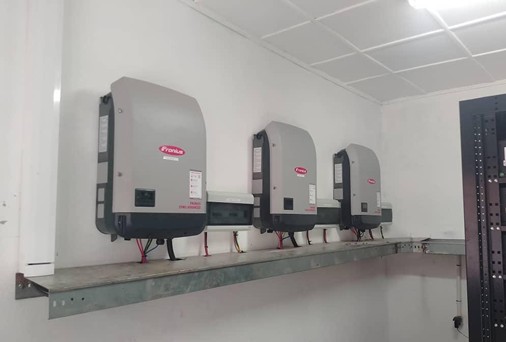
After mechanical and electrical installation, a full commissioning sequence was performed: verifying each PV string’s output, testing inverter functionality, and running the battery through charge/discharge cycles. All parameters (voltages, currents, safety cutouts) were logged. The monitoring system was verified by checking that PV production data and battery metrics appeared correctly on the VRM portal.
To support long-term upkeep, hospital staff were trained in system maintenance and safety. We emphasized routine checks: cleaning the panels (removing dust or debris), inspecting mounts and hardware for corrosion or loosening (wind and thermal cycling can gradually fatigue fasteners), and checking wiring connections for tightness. In short, “regular inspections protect your investment and help ensure your system performs as expected”. The staff also learned to interpret the VRM data – for example, noting if a panel string output drops unexpectedly, or if battery SOC does not recover after a sunny day, which could indicate a fault.
Outcomes and Benefits
Since commissioning, CHUC’s solar plant has dramatically improved energy security. The hospital’s diesel generators are now used only sparingly mostly for emergency backup during extended outages. Power is available day and night from solar-plus-battery, eliminating most generator runs. (A similar MSF-backed hospital in CAR reported that after solar installation they now use only ~1,500 L/month of diesel versus ~5,500 L previously.) Overall this hybrid solar approach cuts fuel consumption and maintenance costs.
Crucially, hospital services now operate uninterrupted. Critical areas like the maternity ward, operating rooms, lab, and vaccine cold storage have stable lighting and electricity. As MSF notes for CAR hospitals, “Solar energy stabilizes the operation of operating rooms, laboratories and cold rooms” and “enhances patient safety by ensuring nighttime lighting and continuous operation of vital equipment”. For example, new mothers and infants benefit from reliable illumination and oxygen concentrators during childbirth – something that was uncertain under the old sporadic power supply. Finally, the project advances sustainability goals. By offsetting diesel use, CHUC drastically lowers its carbon footprint. Prior solar installations in Bangassou were reported to save on the order of 120 tonnes of CO₂ per year. Here at CHUC, the avoided emissions and reduced generator noise not only help the local environment but also free up budget. Funds once earmarked for fuel and generator upkeep can now be redirected to patient care. In summary, the 120 kWp solar system delivers reliable, low-cost, clean power for Bangui’s CHUC hospital – a resilient foundation for better healthcare in the community.


